art

Some notes on distribution

    As many of you no doubt noticed, the exam 3 grades are posted. A number of people earned a perfect score, mad props for that. Here’s a table with statistics for each of the exams as well as for weighted averages that I calculated as follows:

HW + .24*(exam 1 grade) + .28*(exam 2 grade) +.28*(exam 3 grade)
where HW = average of your first eight homework assignments (out of 20 points). Obviously this statistic isn’t perfect, but it’s as good as I can do at the moment. Keep in mind that the rightmost column will change after the final, and it will almost certainly go up 


Exam 1 Exam 2 Exam 3 Weighted Average
25th percentile 55 48.5 70.75 58.52
median 66 68 84 71.77
75th percentile 78 81 90.25 81.93
85th percentile 84 85.2 95 86.15
    As for the final: the reason I made it optional was basically to benefit those of you who have done really well this semester. If you have excellent marks already then you have nothing left to prove on the final, since you’ve already been tested on all the material, so I figure why should I make you sit for a final. Most of you should want to take the final, as it is an opportunity to show what you know and make up for any poor performance earlier in the semester. You’ll have the sheet of notes, so you don’t have to worry about memorizing everything from the whole semester; also, you’ll have choices about which problems to do. 

I saw a painting I liked by Chaim Soutine at the MoMA:

  
It’s called Man in a Green Coat. Soutine lived in Paris around the same time as Amedeo “Mo Diggity, Mo Doubt” Modigliani (and a million other great artists like Chagall and Picasso and all those big dogs). Modigliani is the more famous artist, but that could be partly because of the mythos surrounding his reckless lifestyle (he was a tremendous drunk, hit the hashish hard, and chased the green fairy all around Paris (but mostly Montmartre) until he died at 35). Modigliani painted Soutine a couple of times:
  
but a better work of his is the Red Nude, which I’m not going to post in case some of y’all are sensitive like the Paris Chief of Police who in 1917 shut down Mo Diggity’s exhibition for being too scandalous.
Exam 3 material

Sorry this is a bit late; this week’s been crazy (this whole year’s been crazy, ask the holy spirit to save me, only difference from me and Ossie Davis, gray hair maybe). 

Come to my office hours tomorrow for help and to pick up your homework 8. 
The solutions to homework 9 are now posted.

To do well on Exam 3 you should know all about the following:

– Linear independence
– The span of a set of vectors
– Subspaces 
– col(A), row(A), null(A)
– rank(A)
– Linear transformations
– The condition number of a matrix and what means (Section 3.5)
– Linear regression (Section 4.2)
– The pseudoinverse of a matrix and what it is used for (Section 5.3)
Types of problems are:
– Determine whether a vector is in the span of some set of vectors
– Determine whether a set of vectors forms a basis for a space
– Prove some given set S is a subset of R^n, or finding a counterexample to show that it is not
– Prove that some given transformation T is linear, or finding a counterexample to show that it is not
– Find solution sets to underdetermined, consistent systems
– Find bases for col(A), row(A), null(A)
– Find the dimension of a space 
– Find the rank of a matrix
– Given enough information about A to find its condition number without too much calculation, find cond(A). Given error matrix E, explain what cond(A) tells us about the possible error in our solution to the system Ax = b
– Find q in a regression model y^ = qx
– Find q for a more complicated model by converting data into values that are linearly related (as in section 4.2 #7, 8)
– Set up the regression problem y = qx + r as Xw = y and find least-squares solution w = [q, r] = (pseudoinverse(X)) * (y)
– Given enough information about A to find its pseudoinverse, find the least-squares solution w to Aw = b (the previous bullet point is a special case of this problem)
The best way to study is to redo the homework problems without using the textbook or your notes. Every problem on the exam is similar to some homework problem from the past few weeks.

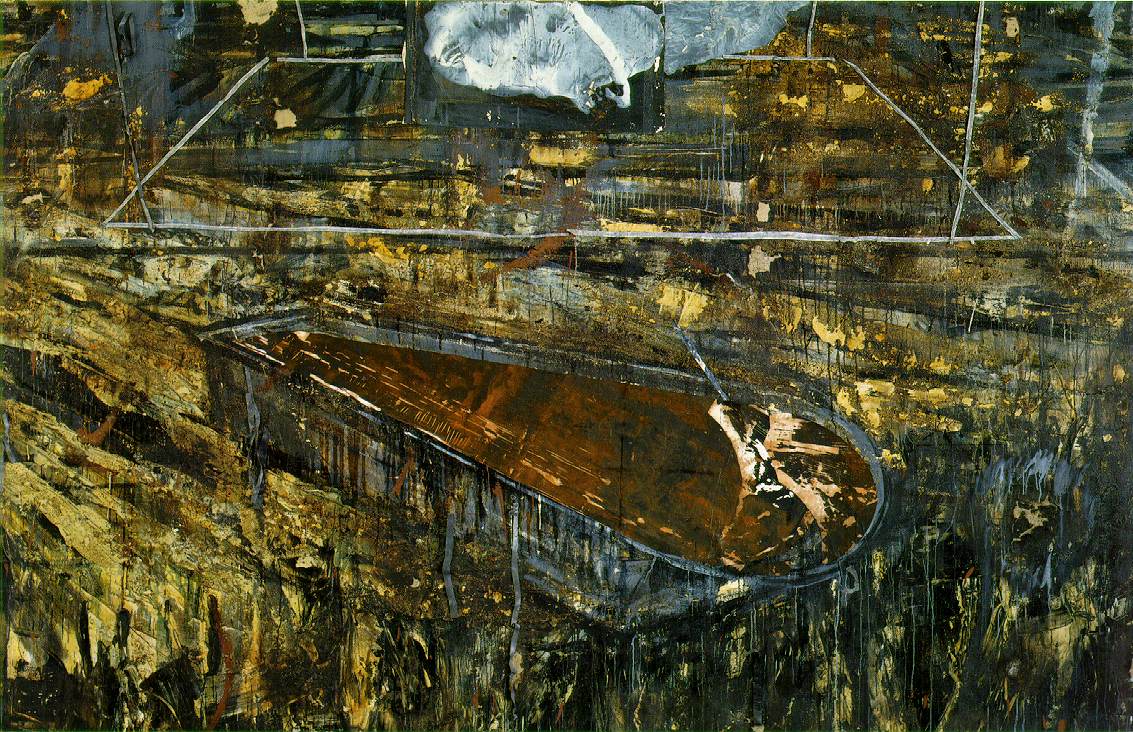
Saw this painting in the MoMA last week, thought it was pretty dope

  
The Red Sea, by Anselm Kiefer

HW 7 Solutions posted / The rest of the year

– You may be interested to know that the solutions to homework 7 are available for viewing in the Documents tab. 

– I will hold office hours as usual tomorrow from 3-5

– Our last in-class test will be on the last day of class: Wednesday 4 December 2013; it will cover all the material we’ve done since the second test. I’ll post a more comprehensive list of subjects for you as the date approaches. Note that there are only two days of new material left. 
– Start thinking about the material you found most difficult throughout the year, so I can focus on that during the review class (Monday 2 December 2013). Send me emails about it and I’ll take note of what people have found most difficult.

So I’m listening to this artist called Druid Cloak and this track Ghost Iron comes up and reminds me of J Dilla which is weird because Druid Cloak is more of a future garage producer but anyway I took it as a sign to mention J Dilla to you, because J Dilla is dope. Donuts is one of the best instrumental albums of all time. That playlist isn’t mixed ideally for listening to the album, but it’s still good. Every time I have cause to say “working on it” I do it like the Dilla track Workinonit. 

Other tight, essential albums: Endtroducing….. by DJ Shadow and Music Has The Right to Children by Boards of Canada (both stone-cold classics), From Here We Go Sublime by The Field and Untrue  by Burial (not really similar albums, but they both came out in the same year and were a big reason I got into electronic music. Actually all five of these albums are quite different from one another.)
Did you know that SUNY students get free admission to the MoMA????? I just found out, and I’m super stoked. Gonna get my Magritte on this weekend! Y’all ain’t ready! 
  
Between that and the Met‘s policy of ‘recommended’ ticket prices (a.k.a., pay two dollars cos I’m poor (one of my friends only gives a penny)) life is good in our fair state for those of high taste and low income.

Clarifications / Exam 2

Yooooooooo,

Two things from class today:
1. The plural of wunderkind is, of course, wunderkinder. I realized as much right after class, (when I thought about the word kindergarten; I also remembered a sentence in a book I read long ago: “eine Schande für die Kinder” (or something like that), which a German woman says to her husband (in a pleasant way) when he is affectionate with her in front of their children. I don’t remember what the book was, though, and Google didn’t help, so if you happen to have the same weirdly specific memory and know whence that sentence comes, PLEASE let me know because it’s bugging me). Coincidentally, I was listening to the piano quintet in B minor by the German composer (and Beethoven chum) Ferdinand Ries when I realized wunderkinder was the right word. I suspect the Germanness of the piece helped me out quite a bit.
2. It’s “Rayleigh coefficient”, not “Raleigh”; I think I wrote the latter name on the board today. (Note: I put the previous sentence’s comma and semicolon outside the quotation marks, in the British style, because Lord Rayleigh was English (I also thinks it makes more sense to write that way)). Lord Rayleigh won the Nobel Prize in Physics, for discovering argon, but is perhaps better known for Rayleigh scattering, which explains why the sky is blue (it’s because it’s been listening to Miles Davis’s soundtrack to Ascenseur pour l’échafaud).
Perhaps more importantly for you, the second exam will be 23 October 2013 (one week from this Wednesday) in class. It will cover chapter 3. I will be more precise with respect to what exactly you need to know sometime after this Wednesday’s class. Don’t forget to do the homework that is due this Wednesday.
_________________________________________________________________________________
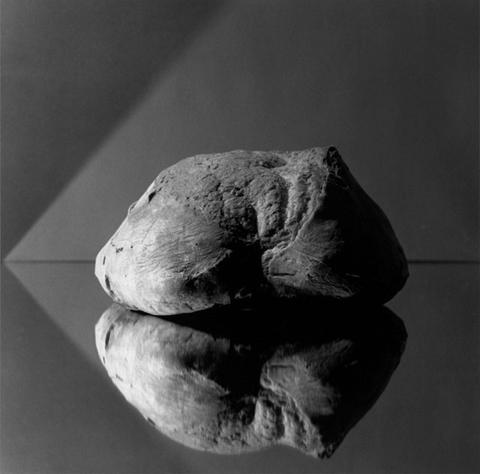
Robert Mapplethorpe was a hugely controversial photographer, but he also once took this lovely picture of bread:
  

Homework 5

Dear Everyone,

Your latest homework assignment is now posted in Tools tab. Just kidding, it’s in the Assignments tab. Gotcha. It’s also at the bottom of this email. Also, I will be in my office tomorrow afternoon (definitely 3-5pm, maybe earlier) if you want to come by and get your test, if you’ve not yet done. I will not be available for extra help during that time, though, I’m afraid. 
_______________________________
– William-Adolphe Bouguereau was a French painter active in the latter half of the 19th century. He was a strict traditionalist, painting in the Academic style throughout his career. Because of his tremendous ability in this domain, he became quite famous and respected; however, his lifetime saw the emergence of an artistic avant-garde, namely the Impressionists, who despised him and (what they saw as) the staid culture he represented. His Classical realism fell out of favor after his death in 1905, leading to a decline in prestige for his works, but renewed interest in representational painting has brought him the respect of the artistic community yet again, and his place in museums around the world is fairly secure. I find his career fascinating to think about: you’ve probably never heard of him, but you certainly know van Gogh and Monet. Why? Because those latter were not just brilliant painters, they were revolutionary geniuses. Being extraordinary at something (Bouguereau could really paint like a mofo) does not guarantee you membership in the G.O.A.T. club. At the same time, traditionalism was just his sensibility. Would he have been betraying himself if he had adapted stylistic advancements in whose merit he didn’t truly believe? Here’s one of his paintings that I think is really beautiful. I’ve seen it at the Met, though it’s not always on display.
wab  
– Beethoven’s Piano Concert No. 5 in E flat major (the Emperor Concerto), was the composer’s final piano concerto, and, like most of Beethoven’s work, it’s extraordinary. To me, the main theme of the first movement sounds like the first verse of Young the Giant’s “My Body“. Thoughts?
HOMEWORK 5:
Section 3.3: 2(a), (c), (e); 7(a), (c), (f); 8(a), (c), (f); 18; 20; 24; 28; 35(a)

Section 3.4: 6(a), (b) [make sure you understand all of Example 4]; 9, 13(a)
Extra credit:
Section 3.3: 35(b) 
Section 3.4: 7(a) (you have to use a computer to calculate powers of a matrix, MATLAB is available on some computers around campus and I think Mathematica, Maple, and MATLAB are available for free through Stony Brook here: http://it.stonybrook.edu/software/catalog. Knowing how to use any or all of them will be extremely useful in your academic career and beyond.  Helps with the ladies, too. And dudes!

Homework 4 posted / old homework

The first part of homework 4 is posted in the Assignments tab. You should get started on it; it’ll be a longer assignment than usual since it covers three lectures of material and you have a week and a half to do it.

Also, come to office hours tomorrow to get your old homeworks (and if you have questions, of course).

Also also, the next exam is tentatively scheduled for Wednesday, 23 October 2013, and will cover chapter 3.
Also also also, how dope is Gursky?
 

Andrew’s office hrs / the big font reveal

TA Andrew will hold office hours on Friday this week, from 9am – 11am in Harriman 010.

The font on the test was Helvetica Light, which has been in the news (as much as a font is ever in the news) because it is the font for Apple’s new mobile operating system iOS 7.
The solutions will be posted no later than tomorrow night, unless something crazy happens.
________________________________________________________________________
Henri Cartier-Bresson was a photographer active in the middle of the 20th century, and an early adopter of the 35mm format, which allowed him to capture the “decisive moment” (this became the English title of his most famous book of photographs). He was one of the first practitioners of street photography, a field in which his influence remains strong.
“Photographier: c’est dans un même instant et en une fraction de seconde reconnaître un fait et l’organisation rigoureuse de formes perçues visuellement qui expriment et signifient ce fait”
(“To me, photography is the simultaneous recognition, in a fraction of a second, of the significance of an event as well as of a precise organization of forms which give that event its proper expression.”)
*Incidentally, I originally wrote “He was one of the first street photographers, a field in which his influence remains strong.” I changed it because “street photographers” isn’t a field, “street photography” is. Quick grammar tip.

HW 3 solutions + NO GRAPHING CALCULATORS ALLOWED

The solutions to homework 3 are posted in the Documents tab. Also, you’re not allowed to use graphing calculators on the exam; scientific or four-function calculators are permitted, but not the one on your mobile telephone device. Obviously. 
This is Goya’s painting Perro semihundido, sometimes called simply El perro. When the great Catalan painter Joan Miró visited the Museo del Prado for the last time before his death, he requested to see two paintings: Las meninas by Velázquez, which is the greatest painting of all time, and El perro.
 

Suggested practice problems for Wednesday’s Exam 1

Section 1.3: 5, 7, 9

Section 1.4: 9
Section 2.1: 5
Section 2.2: 3, 5, 17, 27, 33
Section 2.4: 9, 25(a), 31
Section 2.5: 5, 7, 9, 11, 15
– You should also review mathematical induction and the examples thereof that we did in class. Another exercise in induction: prove that the sum of the first n positive integers is n(n+1)/2.
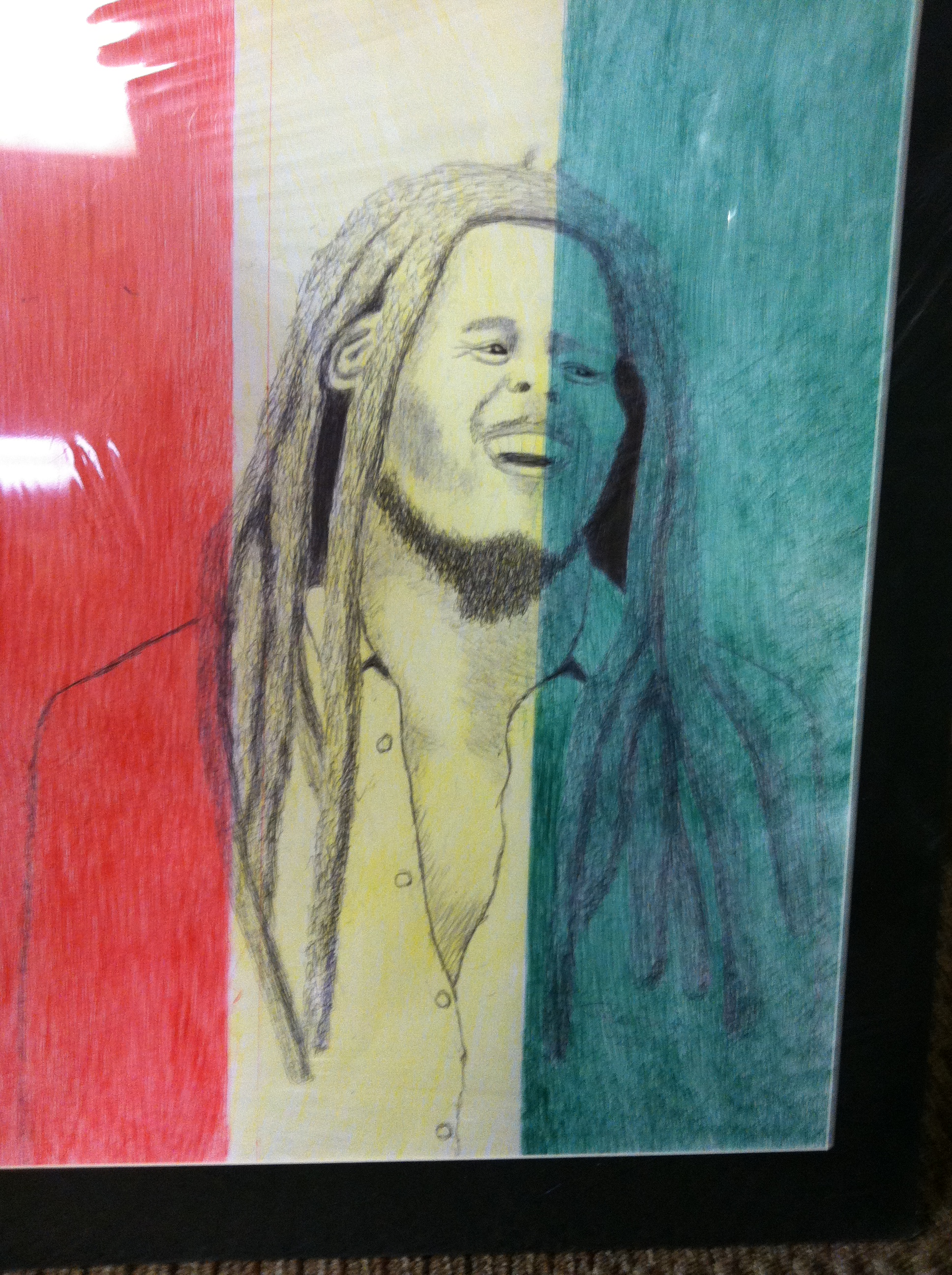
– After you’re done with that, check out this picture of Bob Marley that was for sale for $100 at a visitor center near the Grand Canyon:
bob 2013-08-08 11.46.45
One hundred American dollars for that.