music

Clarifications / Exam 2

Yooooooooo,

Two things from class today:
1. The plural of wunderkind is, of course, wunderkinder. I realized as much right after class, (when I thought about the word kindergarten; I also remembered a sentence in a book I read long ago: “eine Schande für die Kinder” (or something like that), which a German woman says to her husband (in a pleasant way) when he is affectionate with her in front of their children. I don’t remember what the book was, though, and Google didn’t help, so if you happen to have the same weirdly specific memory and know whence that sentence comes, PLEASE let me know because it’s bugging me). Coincidentally, I was listening to the piano quintet in B minor by the German composer (and Beethoven chum) Ferdinand Ries when I realized wunderkinder was the right word. I suspect the Germanness of the piece helped me out quite a bit.
2. It’s “Rayleigh coefficient”, not “Raleigh”; I think I wrote the latter name on the board today. (Note: I put the previous sentence’s comma and semicolon outside the quotation marks, in the British style, because Lord Rayleigh was English (I also thinks it makes more sense to write that way)). Lord Rayleigh won the Nobel Prize in Physics, for discovering argon, but is perhaps better known for Rayleigh scattering, which explains why the sky is blue (it’s because it’s been listening to Miles Davis’s soundtrack to Ascenseur pour l’échafaud).
Perhaps more importantly for you, the second exam will be 23 October 2013 (one week from this Wednesday) in class. It will cover chapter 3. I will be more precise with respect to what exactly you need to know sometime after this Wednesday’s class. Don’t forget to do the homework that is due this Wednesday.
_________________________________________________________________________________
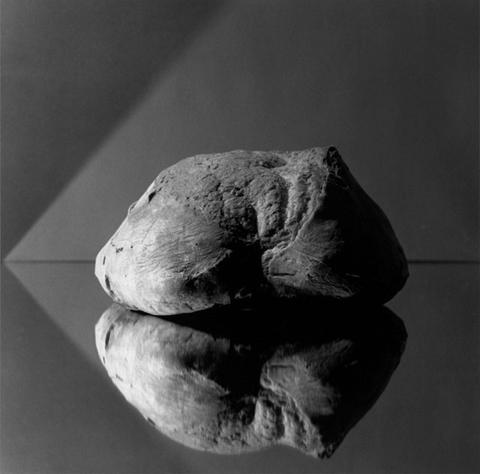
Robert Mapplethorpe was a hugely controversial photographer, but he also once took this lovely picture of bread:
  

Homework 5

Dear Everyone,

Your latest homework assignment is now posted in Tools tab. Just kidding, it’s in the Assignments tab. Gotcha. It’s also at the bottom of this email. Also, I will be in my office tomorrow afternoon (definitely 3-5pm, maybe earlier) if you want to come by and get your test, if you’ve not yet done. I will not be available for extra help during that time, though, I’m afraid. 
_______________________________
– William-Adolphe Bouguereau was a French painter active in the latter half of the 19th century. He was a strict traditionalist, painting in the Academic style throughout his career. Because of his tremendous ability in this domain, he became quite famous and respected; however, his lifetime saw the emergence of an artistic avant-garde, namely the Impressionists, who despised him and (what they saw as) the staid culture he represented. His Classical realism fell out of favor after his death in 1905, leading to a decline in prestige for his works, but renewed interest in representational painting has brought him the respect of the artistic community yet again, and his place in museums around the world is fairly secure. I find his career fascinating to think about: you’ve probably never heard of him, but you certainly know van Gogh and Monet. Why? Because those latter were not just brilliant painters, they were revolutionary geniuses. Being extraordinary at something (Bouguereau could really paint like a mofo) does not guarantee you membership in the G.O.A.T. club. At the same time, traditionalism was just his sensibility. Would he have been betraying himself if he had adapted stylistic advancements in whose merit he didn’t truly believe? Here’s one of his paintings that I think is really beautiful. I’ve seen it at the Met, though it’s not always on display.
wab  
– Beethoven’s Piano Concert No. 5 in E flat major (the Emperor Concerto), was the composer’s final piano concerto, and, like most of Beethoven’s work, it’s extraordinary. To me, the main theme of the first movement sounds like the first verse of Young the Giant’s “My Body“. Thoughts?
HOMEWORK 5:
Section 3.3: 2(a), (c), (e); 7(a), (c), (f); 8(a), (c), (f); 18; 20; 24; 28; 35(a)

Section 3.4: 6(a), (b) [make sure you understand all of Example 4]; 9, 13(a)
Extra credit:
Section 3.3: 35(b) 
Section 3.4: 7(a) (you have to use a computer to calculate powers of a matrix, MATLAB is available on some computers around campus and I think Mathematica, Maple, and MATLAB are available for free through Stony Brook here: http://it.stonybrook.edu/software/catalog. Knowing how to use any or all of them will be extremely useful in your academic career and beyond.  Helps with the ladies, too. And dudes!

Exam 1 solutions available for your perusal

I know what you’ve been thinking. “Ayo what’s good with those exam 1 solutions? When will they be available for our perusal? I’m mad curious about the solutions and it’s keeping me up at night.” Well, dear students, here they are. Enjoy the bounty, for life’s but a walking shadow, a poor player that struts and frets his hour upon the stage and then is heard no more. It is a tale told by an idiot, full of sound and fury, signifying nothing.

And I know I said I’d have the solutions up by Thursday night, and technically it’s Friday right now, but how do you know I’m not in the Central Time Zone? I didn’t say it would be Thursday night everywhere in the world.
Nah, I’m in New York. But I did post the solutions on Thursday night. Check the timestamp yo.

___________________________________________________________________________

Steve Reich is one of the great composers of the 20th (and 21st) century; he, along with La Monte Young, Terry Riley, and Philip Glass, developed the style of music that became known as minimalism (though Glass prefers the term “music with repetitive structures”). His most famous piece is Music for 18 Musicians, and it’s crazy good. I was fortunate enough to catch a performance at a chapel at Vassar College about five years ago. That year I also saw a 45th anniversary performance of Riley’s In C at Carnegie Hall in which Philip Glass, the Kronos Quartet, and Riley himself were among the performers. It was tight.